History of the AA Preamble
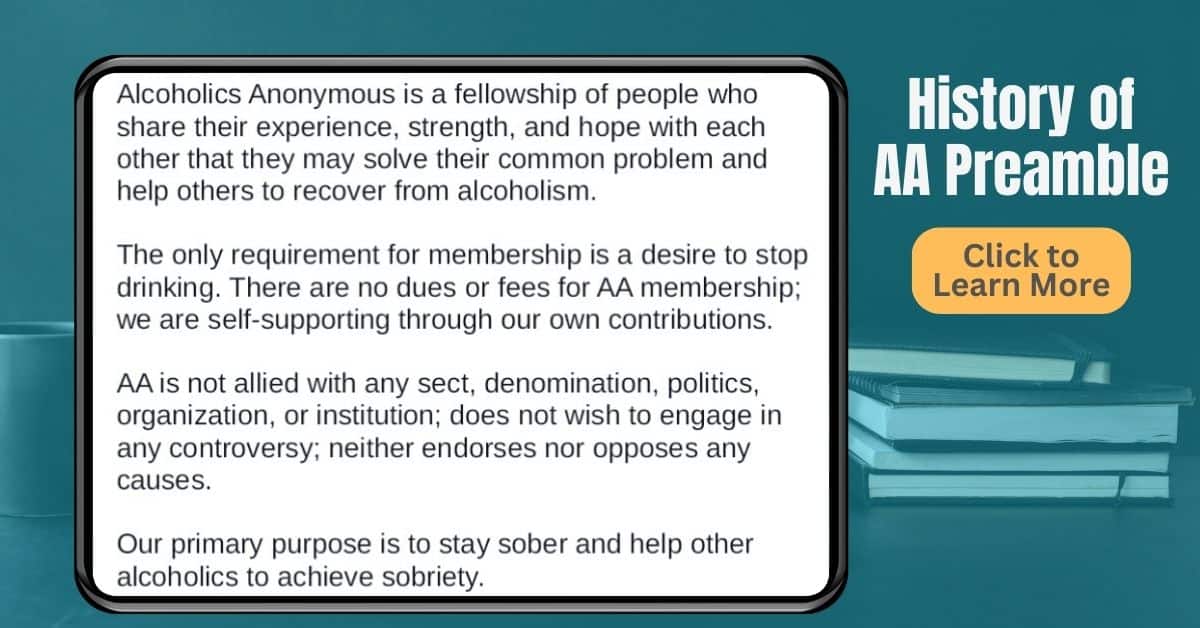
Not long ago, a single change was made to the AA Preamble to modernize it to non-gender-specific language. The change was simple: “Alcoholics Anonymous is a fellowship of men and women…” was changed to “Alcoholics Anonymous is a fellowship of people…”
This is now the simplified, gender-approved update to the AA Preamble.
Alcoholics Anonymous is a fellowship of PEOPLE who share their experience, strength, and hope with each other that they may solve their common problem and help others to recover from alcoholism.
The only requirement for membership is a desire to stop drinking. There are no dues or fees for AA membership; we are self-supporting through our own contributions. AA is not allied with any sect, denomination, politics, organization or institution; does not wish to engage in any controversy, neither endorses nor opposes any causes. Our primary purpose is to stay sober and help other alcoholics to achieve sobriety.
But it has evolved significantly since June 1947 when the editors composed and published it in the AA Grapevine.
The Grapevine had just begun to circulate among non-alcoholics, and the Preamble was intended primarily to describe for them what AA is and is not. It is still often used for public information purposes.
As time passed, it began appearing in all Conference-approved publications, and many groups now use it to open meetings.
How has it changed?
The current version that we know today has undergone some changes from its original version. For instance:
- It stated that the only requirement for membership is an HONEST desire to stop drinking, and
- It contained only the very brief statement, “AA has no dues or fees.”
At the 1958 General Service Conference, a delegate pointed out that the word “honest” does not appear in the Third Tradition and suggested that it should be deleted from the Preamble. Many delegates felt that as AA had matured, it had become almost impossible to determine what constitutes an honest desire to stop drinking and also that some who might be interested in the program could be confused by the phrase. The mid-summer 1958 meeting of the General Service Board ratified the deletion, and since then, the Preamble has read simply “a desire to stop drinking.”
The phrase “AA has no dues or fees” also was clarified to read as it presently does: “There are no dues or fees for AA membership, we are self-supporting through our own contributions.” The current version of the Preamble appears on the first page of every issue of the Grapevine. But it’s not the only version.
Other AA Preambles
A few months after the Grapevine published the Preamble in June 1947, Ollie L., Dick F., and Searcy W. decided to beef it up for the drunks in Texas.
“We worked on it, passed it around, and agreed on this version,” says Searcy W. “It’s now read by groups throughout the state.” It works for Searcy. At the time of this interview, he had been sober for 54 years. The full text is below.
Texas Preamble:
“Alcoholics Anonymous is a fellowship of men and women who share their experience, strength and hope with each other that they may solve their common problem and help others to recover from alcoholism.
We are gathered here because we are faced with the fact that we are powerless over alcohol, and are unable to do anything about it without the help of a Power greater than ourselves.
We feel each person’s religious convictions, if any, are his own affair, and the simple purpose of the program of AA is to show what may be done to enlist the aid of a Power greater than ourselves, regardless of what our individual conception of that Power may be.
In order to form a habit of depending upon and referring all we do to that Power, we must first apply ourselves with some diligence, but repetition confirms and strengthens this habit, then faith comes naturally.
We have all come to know that as alcoholics we are suffering from a serious disease for which medicine has no cure. Our condition may be the result of an allergic reaction to alcohol, which makes it impossible for us to drink in moderation. This condition has never, by any treatment with which we are familiar, been permanently cured. The only relief we have to offer is absolute abstinence – a second meaning of AA.
There are no dues or fees. The only requirement is an honest desire to stop drinking. Each member is a person with an acknowledged alcoholic problem who has found the key to abstinence from day to day by adhering to the program of Alcoholics Anonymous. The moment he resumes drinking he loses all status as a member of AA. His reinstatement is automatic, however, when he again fulfills the sole requirement for membership – an honest desire to quit drinking.
Not being reformers we offer our experience only to those who want it. AA is not interested in sobering up drunks who are seeking only temporary sobriety. We have a way out on which we can absolutely agree and in which we join in harmonious action. Rarely have we seen a person fail who has thoroughly followed our path. Those who do not recover are those who will not or cannot lend themselves to this simple program– usually men and women who are incapable of being honest with themselves. You may like this Program or you many not, but the fact remains that is works.. and we believe it is our only chance to recover.”
The AA fellowship is full of fun activities. Some people might be surprised by how casual and lighthearted we seem, but deep down we take our problem with alcoholism very seriously. Our top priority is to address this issue. We need faith to guide us constantly throughout the day, or else we risk failure.
The Wilmington or Baltimore AA Preamble:
The Wilmington Preamble has been a point of controversy since its inception in the early years of Alcoholics Anonymous. The history of our fellowship has been passed from member to member over many years, but memories can be flawed, and inaccuracies may prevail. The following is not an attempt to dispel these controversies, but rather an effort to establish an accurate history of the Wilmington Preamble and to preserve its true history for future generations. We welcome any documentable corrections to this history.
The Wilmington Preamble’s origins are tied to one of Wilmington’s earliest members, Shoes L. In May of 1944, Shoes joined the Wilmington Group and became sober. The following month, he was appointed as Chairman of the group and was responsible for finding speakers for their meetings.
At that time, a sportswriter named Mickey M. was in town covering the horseraces at Delaware Park. Shoes approached him to speak at the meeting, but Mickey declined, saying that he wasn’t a good speaker. Instead, he offered to write something appropriate. Mickey reportedly went back to his room at the Hotel Dupont and wrote the Wilmington Preamble as we know it today. The group read it for the first time on the following Friday night.
As a sportswriter, Mickey M. used to report on events in different cities. Once, while covering the races at Pimlico in Baltimore, he shared a preamble with the Baltimore Group, who later adopted it as their own. The origin of this preamble is controversial, but it is certain that it was widely accepted in Maryland and Delaware long before the World Service approved the shorter A.A. Preamble that is now more commonly used.
This is it:
“We of Alcoholics Anonymous are a group of persons for whom alcohol has become a major problem. We have banded together in a sincere effort to help ourselves and other problem drinkers recover health and maintain sobriety.
Definitions of alcoholics are many and varied. For brevity we think of an alcoholic as one whose life has become unmanageable to any degree due to the use of alcohol.
We believe that the alcoholic is suffering from a disease for which no cure has yet been found. We profess no curative powers but have formulated a plan to arrest alcoholism.
From the vast experience of our many members we have learned that successful membership demands total abstinence. Attempts at controlled drinking by the alcoholic inevitably fail.
Membership requirements demand only a sincere desire on the part of the applicant to maintain total abstinence.
There are no dues of fees in A.A.; no salaried officers. Money necessary for operating expenses is secured by voluntary contributions.
Alcoholics Anonymous does not perform miracles, believing that such powers rests only in God.
We adhere to no particular creed or religion. We do believe, however, that an appeal for help to one’s own interpretation of a higher power, or God, is indispensable to a satisfactory adjustment to life’s problems.
Alcoholics Anonymous is not a prohibition or temperance movement in any sense of the word. We have no criticism of the controlled drinker. We are concerned only with the alcoholic.
We attempt to follow a program of recovery which has for its chief objectives: Sobriety for ourselves; help for other alcoholics who desire it; amends for past wrongs; humility; honesty; tolerance; and spiritual growth.
We welcome and appreciate the cooperation of the medical profession and the help of the clergy.”
Possibly the earliest version of the AA Preamble (1940) below:
“We are gathered here because we are faced with the fact that we are powerless over alcohol and unable to do anything about it without the help of a Power greater than ourselves. We feel that each person’s religious views, if any, are his own affair. The simple purpose of the program of Alcoholics Anonymous is to show what may be done to enlist the aid of a Power greater than ourselves, regardless of what our individual conception of that Power may be.
In order to form a habit of depending upon and referring all we do to that Power, we must at first apply ourselves with some diligence. By often repeating these acts, they become habitual and the help rendered becomes natural to us.
We have all come to know that as alcoholics we are suffering from a serious illness for which medicine has no cure. Our condition may be the result of an allergy which makes us different from other people. It has never been by any treatment with which we are familiar, permanently cured. The only relief we have to offer is absolute abstinence, the
second meaning of A.A.
There are no dues or fees. The only requirement for membership is a desire to stop drinking. Each member squares his debt by helping others to recover.
An Alcoholics Anonymous is an alcoholic who through application and adherence to the A.A. program has forsworn the use of any and all alcoholic beverage in any form. The moment he takes so much as one drop of beer, wine, spirits or any other alcoholic beverage he automatically loses all status as a member of Alcoholics Anonymous. A.A. is not interested in sobering up drunks who are not sincere in their desire to remain sober for all time. Not being reformers, we offer our experience only to those who want it.
We have a way out on which we can absolutely agree and on which we can join in harmonious action. Rarely have we seen a person fail who has thoroughly followed our program. Those who do not recover are people who will not or simply cannot give themselves to this simple program. Now you may like this program or you may not, but the fact remains, it works. It is our only chance to recover.
There is a vast amount of fun in the A.A. fellowship. Some people might be shocked at our seeming worldliness and levity but just underneath there lies a deadly earnestness and a full realization that we must put first things first and with each of us the first thing is our alcoholic problem. To drink is to die. Faith must work twenty-four hours a day in
and through us or we perish.
In order to set our tone for this meeting I ask that we bow our heads in a few moments of silent prayer and meditation.
I wish to remind you that whatever is said at this meeting expresses our own individual opinion as of today and as of up to this moment. We do not speak for A.A. as a whole and you are free to agree or disagree as you see fit, in fact, it is suggested that you pay no attention to anything which might not be reconciled with what is in the A.A. Big Book.
If you don’t have a Big Book, it’s time you bought you one. Read it, study it, live with it, loan it, scatter it, and then learn from it what it means to be an A.A.”