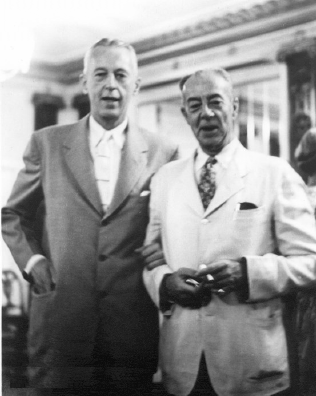
Ebby Thacher, often overshadowed in the history of Alcoholics Anonymous (AA), played a crucial role in forming the fellowship by bringing the principles of the Oxford Group to his old friend, Bill Wilson. Ebby’s story is one of early influence, personal struggle, and a complex relationship with sobriety that offers a profound lesson on the challenges of addiction and recovery.
Early Life and Connection with Bill W.
Born Edwin Throckmorton Thacher on April 29, 1896, in Albany, New York, Ebby came from a prominent and affluent family. His grandfather was a successful manufacturer, and his relatives included the mayor of Albany. Ebby and Bill Wilson met during their school years at Burr and Burton Seminary in Manchester, Vermont, where they forged a bond over shared interests and, eventually, mutual struggles with alcoholism.
The Transformative Visit
In November 1934, Ebby visited Bill Wilson at his home in Brooklyn. At this point, Bill was deep in the throes of alcoholism. Expecting to spend the day drinking, Bill was stunned when Ebby refused his offer of a drink, instead announcing, “I’ve got religion.” Ebby shared his recent experiences with the Oxford Group. This Christian fellowship emphasized absolute honesty, purity, unselfishness, and love, alongside the importance of seeking a spiritual conversion to overcome alcoholism.
Ebby’s message struck a chord with Bill, who couldn’t shake the impact of his friend’s sober demeanor and conviction. This encounter planted the seeds for Bill’s spiritual awakening, which occurred shortly after at Towns Hospital, where he experienced a profound white light moment that he later described as a spiritual rebirth.
Ebby’s Influence on AA
Ebby’s influence on Bill was profound. He introduced Bill to the spiritual principles that would eventually form the foundation of AA’s Twelve Steps. Despite his struggles with maintaining sobriety, Ebby outlined a simple program of action for Bill, emphasizing the need to work with other alcoholics to achieve spiritual growth. This approach became a cornerstone of AA’s methodology.
Struggles with Sobriety
Despite his pivotal role in Bill Wilson’s recovery, Ebby Thacher’s journey with sobriety was fraught with difficulty. After helping Bill, Ebby himself relapsed and continued to struggle with alcoholism for much of his life. He had periods of sobriety, including a notable stint in Texas, where he managed to stay sober for eight years while working at a clinic and being embraced by the local AA community. However, these periods were often interrupted by relapses, and Ebby’s life became a series of ups and downs.
Later Years and Death
Ebby spent his later years moving between various jobs and living situations, frequently aided by Bill Wilson, who never forgot the debt he owed his friend. Bill provided financial support and arranged for Ebby to stay at treatment facilities and with supportive friends. In the final years of his life, Ebby found peace and sobriety at a rest farm in Galway, New York, managed by Margaret and Mickey M., where he received compassionate care until his death on March 21, 1966, from emphysema.
Complex Legacy
Ebby Thacher’s relationship with Bill Wilson and AA was complex. While Bill always acknowledged Ebby’s crucial role in his recovery, Ebby himself struggled with feelings of resentment and inadequacy, believing he never received the recognition he deserved for his contributions. Lois Wilson, Bill’s wife, noted that while Bill sought sobriety with all his heart. Ebby seemed to desire just enough to stay out of trouble, a factor that may have contributed to his repeated relapses.
Ebby Thacher’s legacy in AA poignantly reminds us of the difficulties inherent in the journey to sobriety. His initial message to Bill Wilson was a catalyst for the creation of one of the most significant recovery movements in history.
However, his struggles underscore that the path to recovery is not straightforward and is fraught with challenges. Ebby’s story, with its highs and lows, highlights the importance of perseverance, the power of support, and the enduring impact one person’s message can have on the lives of millions.


